
One moment, your garage door remote works perfectly, and the next, it refuses to respond, no matter how many times you press the button. This sudden failure can be frustrating and inconvenient, especially when you are rushing out the door or dealing with the intense heat in Cypress, TX. A non-working garage door remote can disrupt your routine and leave you wondering whether the issue is minor or something more serious.
The good news is that most garage door remote problems are caused by a few common and easily identifiable issues. From dead batteries to signal interference or opener malfunctions, many of these problems can be quickly diagnosed without guesswork.
The Battery Is Dead or Weak
This is the most frequent reason a garage door remote stops working, and it is also the easiest to overlook. A battery that is running low may not be completely dead, but it can produce an inconsistent or weak signal that makes the remote unreliable.
Here is what to check:
- Replace the battery first: Before assuming anything else is wrong, swap in a fresh battery. Most remotes use a CR2032 coin cell or AA/AAA batteries.
- Check for corrosion: If the battery compartment has any white or greenish residue, that corrosion is interrupting the connection. Clean it gently with a dry cloth or a small amount of rubbing alcohol on a cotton swab.
- Use quality batteries: Cheap batteries drain faster, especially in heat. In Cypress, TX, where temperatures inside a closed garage can climb significantly, battery life shortens faster than in cooler climates.
If the remote works after a battery change, you have solved the problem. If it still does not respond, move on to the next possible cause. Before assuming you need a full replacement, read How to Know Which Garage Door Remote to Buy so you are prepared if a new remote turns out to be necessary.
The Remote Is Out of Range
Garage door remotes are designed to work within a certain distance from the opener. If you are pressing the button too far away or from an unusual angle, the signal may not reach the motor unit.
- Standard range: Most remotes work reliably within 20 to 30 feet of the opener.
- Obstructions matter: Thick walls, metal shelving near the motor unit, and even certain types of insulation can reduce signal range.
- Test it: Stand directly in front of the garage door and press the button from close range. If it works up close but not from farther away, the antenna or signal strength may be the issue.
The antenna on your opener motor unit is a small wire that should hang down freely. If it is bent, coiled, or tucked away, straightening it can restore the full range of your remote.
The Remote Needs to Be Reprogrammed
Over time, remotes can lose their programmed connection to the opener. This can happen after a power outage, when the opener’s memory is accidentally cleared, or simply from normal wear.
Signs that reprogramming may be the fix:
- The remote worked fine and then suddenly stopped with no obvious cause
- You recently had a power surge or outage
- Someone in the household accidentally held the learn button on the opener
To reprogram, locate the learn button on your garage door opener motor unit. Press and release it, then press the button on your remote within 30 seconds. The exact steps vary by brand, so check your owner’s manual or the manufacturer’s website for model-specific instructions.
Interference From Other Devices
Radio frequency interference is a growing issue as more wireless devices fill our homes and neighborhoods. Your remote communicates on a specific frequency, and other devices nearby can disrupt that signal.
Common sources of interference include:
- LED light bulbs: Certain LED bulbs installed in or near the garage emit frequencies that interfere with remote signals. Switching to an incandescent or garage door opener-compatible LED bulb can resolve the issue.
- Neighbors’ devices: In neighborhoods with closely spaced homes, another homeowner’s wireless system can occasionally conflict with yours.
- Security cameras and smart home hubs: These devices broadcast signals that can occasionally overlap with your remote’s frequency.
If interference is the cause, the remote may work some of the time but fail inconsistently. Testing the remote at different times of day or with nearby devices powered off can help you narrow down the source.
The Remote Has Physical Damage
Remotes take a beating. They get dropped, sat on, left in hot cars, and tossed into junk drawers. Physical damage is a common and often overlooked reason a remote stops working.
Check for the following:
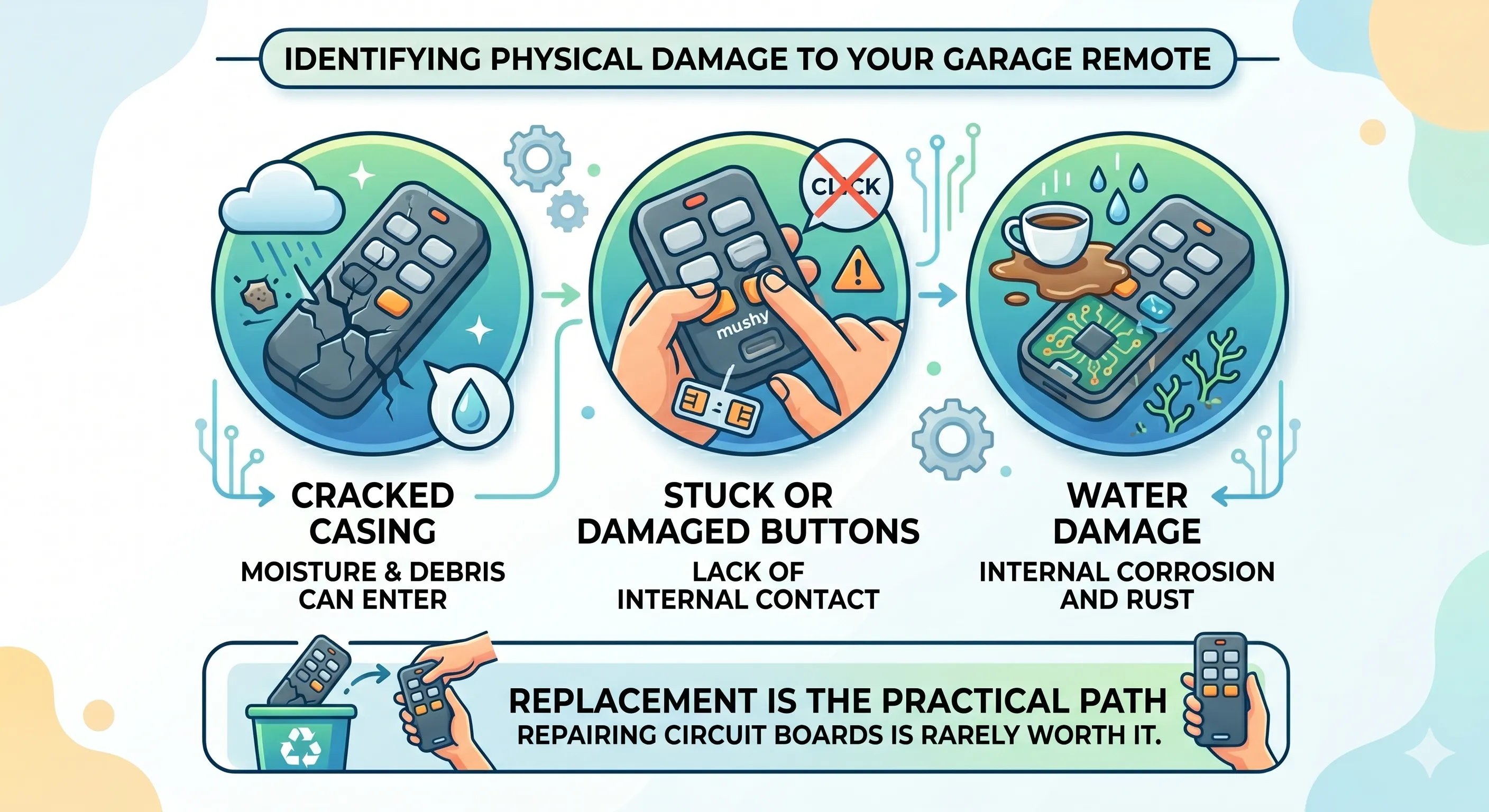
- Cracked casing: A cracked housing can allow moisture or debris inside, damaging the circuit board.
- Stuck or damaged buttons: If a button feels mushy, does not click properly, or is physically depressed, it may no longer make proper contact internally.
- Water damage: Even a brief exposure to rain or a spilled drink can cause internal corrosion that is not visible from the outside.
If the remote shows any of these signs, replacement is usually the most practical path. Attempting to repair the internal circuit board is rarely worth the time or cost.
The Opener’s Logic Board Has an Issue
If you have ruled out the remote itself, the problem may be with the garage door opener rather than the remote. The logic board is the brain of the opener, and when it malfunctions, it can cause the system to stop responding to remote signals entirely.
Signs that the logic board may be the issue:
- The wall button inside the garage also stops working
- The opener responds to some commands but not others
- You notice unusual behavior, like the door reversing on its own or lights flickering
When these symptoms appear, a garage door repair assessment is needed to identify the root cause and restore normal operation.
The Safety Sensors Are Misaligned or Blocked
While safety sensors primarily control whether the door closes, a misalignment or blockage can sometimes affect the entire system’s responsiveness, including remote operation.
Here is what to check:
- Sensor lights: Each sensor should have a steady light. A blinking or absent light signals misalignment or obstruction.
- Clear the path: Remove any objects sitting in front of or near the sensors.
- Realign the sensors: Loosen the mounting bracket slightly, adjust the sensor until the light is steady, and retighten. Both sensors should face each other directly.
In Cypress, TX, cobwebs, dust buildup, and moisture from humidity are common culprits that knock sensors out of alignment or block their signal over time.
Garage door opener safety systems rely on properly aligned photo-eye sensors to prevent unsafe closing, which is why they must remain clear, correctly positioned, and free from obstruction at all times.
The Remote Signal Is Being Blocked by Structural Changes
If you have recently made changes to your garage, such as adding insulation, installing metal shelving, or mounting new equipment near the opener, these changes can interfere with the remote signal path.
- Metal surfaces reflect and absorb radio signals
- Dense insulation panels near the motor unit can reduce signal penetration
- Repositioning the motor unit or its antenna may restore full remote function
This is a subtle cause that homeowners often miss because the remote worked fine before the changes were made. Thinking back to when the problem started can help you connect the dots.
Garage doors operate as integrated systems where the door structure, installation setup, and opener placement all influence overall performance and reliability.
It May Be Time for a New Remote or a New Opener
Sometimes a remote simply reaches the end of its useful life. Internal components wear out, especially after years of regular use and exposure to temperature changes. If you have gone through all the steps above and nothing has resolved the issue, replacement is the logical next step.
If the remote is old, it is also worth evaluating the age of your opener at the same time. An opener that is 15 or more years old may be due for an upgrade regardless.
Reading What Happens If You Use the Wrong Garage Door Remote can help you avoid making a mismatched purchase when you are ready to replace.
When replacing, make sure you buy a remote that is fully compatible with your specific opener model. Buying the wrong remote is a common and avoidable mistake.
What You Should Do Before Replacing Anything
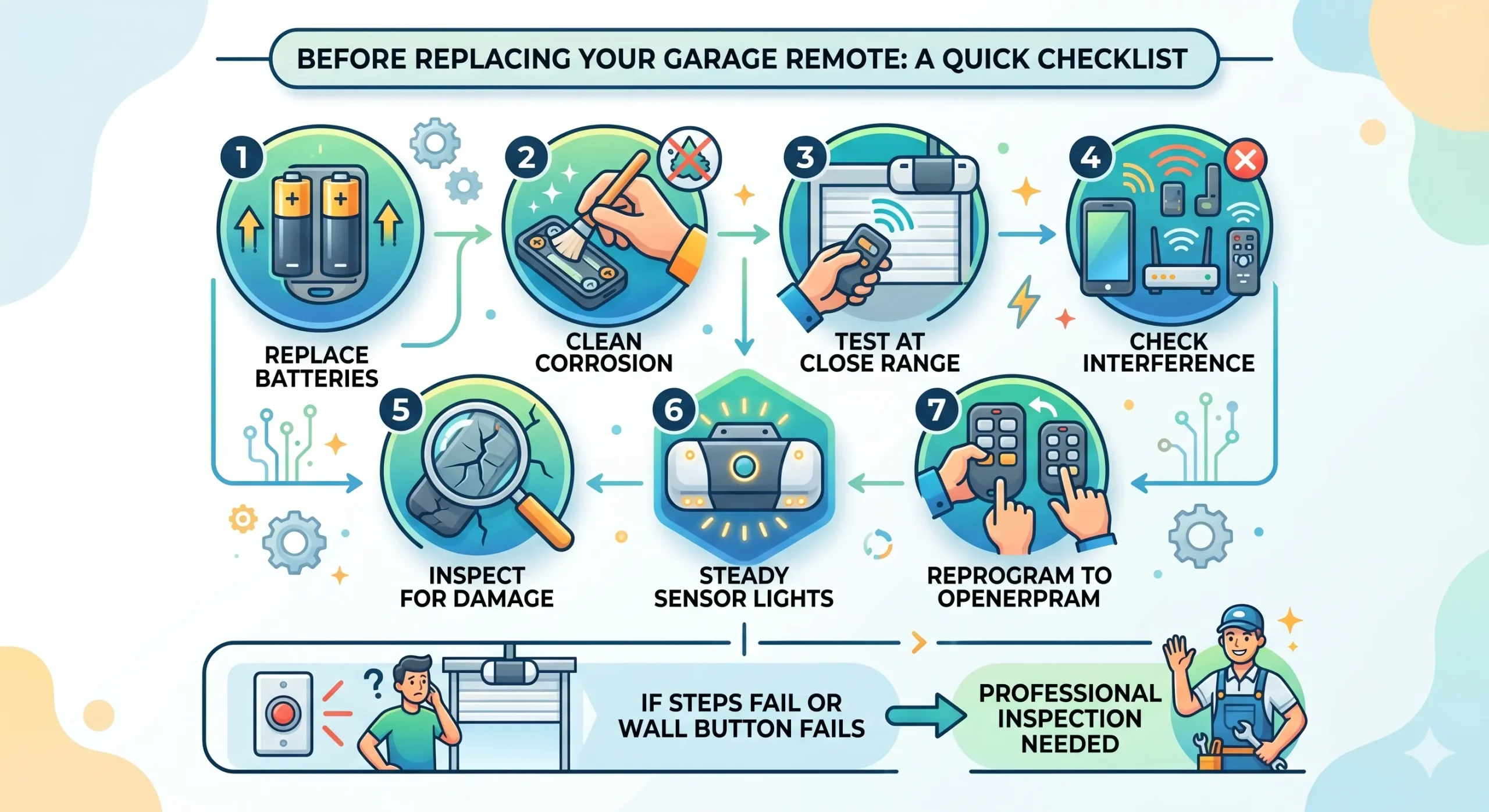
Before spending money on a new remote or calling for a service visit, run through this quick checklist:
- Replace the battery with a fresh one
- Check for corrosion in the battery compartment
- Test the remote at close range
- Check for nearby devices that may cause interference
- Inspect the remote for visible physical damage
- Check that the sensor lights are steady
- Try reprogramming the remote to the opener
If none of these steps resolve the problem, or if the wall button inside the garage also fails to work, the issue is most likely with the opener itself. At that point, a professional inspection is the right move.
To plan ahead for that scenario, read When and How to Replace Your Garage Door Remote so you know what the process looks like before you begin.
When a Simple Remote Problem Becomes a Bigger One
A garage door remote that suddenly stops working might seem like a small inconvenience, but it can often point to a deeper issue within your system. Faults in the opener, wiring, or safety sensors can begin subtly and worsen over time if left unaddressed. In a place like Cypress, TX, where heat, humidity, and seasonal shifts put added strain on garage door components, small problems can escalate quickly. Taking action early helps prevent more costly repairs and keeps your system running reliably.
Garage Door Wizard provides expert service when basic troubleshooting is not enough. Our experienced technicians perform a full system inspection, identify the root cause of the issue, and restore smooth, dependable operation. Whether the problem stems from a faulty remote or a larger system concern, you can expect accurate solutions and reliable results. Contact us or give us a call to schedule your appointment.