
It may seem like a simple decision, choosing a garage door remote that looks similar to your original and assuming it will work. However, using the wrong garage door remote can lead to more than just programming issues. An incompatible remote can disrupt communication with your opener, cause inconsistent operation, and place unnecessary strain on your garage door system. Over time, this mismatch can affect performance, reliability, and even the safety of your setup.
Many homeowners in Cypress, TX, do not recognize the risks until noticeable problems begin to develop. From signal interference and reduced responsiveness to potential security concerns, the impact can be significant. Understanding what happens when you use the wrong garage door remote, along with the warning signs to watch for, can help you avoid unnecessary damage and keep your garage door system operating smoothly and securely.
The Remote Simply Will Not Communicate With Your Opener
The most immediate result of using the wrong remote is that it will not work at all. This happens because garage door openers and remotes must share the same frequency and programming protocol to communicate.
Here is why the signal fails:
- Frequency mismatch: If your opener runs on 315 MHz and your remote is designed for 390 MHz, they will never connect, no matter how many times you attempt to program it.
- Protocol incompatibility: Brands like LiftMaster, Genie, and Chamberlain each use their own communication protocols. A remote built for one brand will not understand the language of another.
- Rolling code conflict: If your opener uses rolling code security and your remote does not support it, the two cannot establish a reliable connection.
Before buying any remote, always confirm the brand, model, and frequency of your opener. Our guide on How to Know Which Garage Door Remote to Buy walks you through each step to get it right the first time.

You May Accidentally Interfere With a Neighbor’s System
This is a risk that surprises most homeowners. If you use a remote that operates on the same frequency as a neighbor’s garage door opener, pressing your remote could trigger their door instead of yours.
Why this happens:
- Older fixed-code remotes broadcast on a shared frequency with no unique identifier
- In neighborhoods with homes in close proximity, like many communities in Cypress, TX, the signal from your remote can easily reach a neighboring garage
- This can cause unintended access to a neighbor’s garage or confuse both systems simultaneously
Rolling code technology was introduced specifically to address this problem. If your current system still uses fixed-code technology, this is a strong reason to consider upgrading to a more secure and modern opener.
These interference risks are further explained in Why Your Garage Door Remote Stopped Working, especially in older systems still in use today.
Repeated Failed Programming Attempts Can Disrupt Your Opener’s Memory
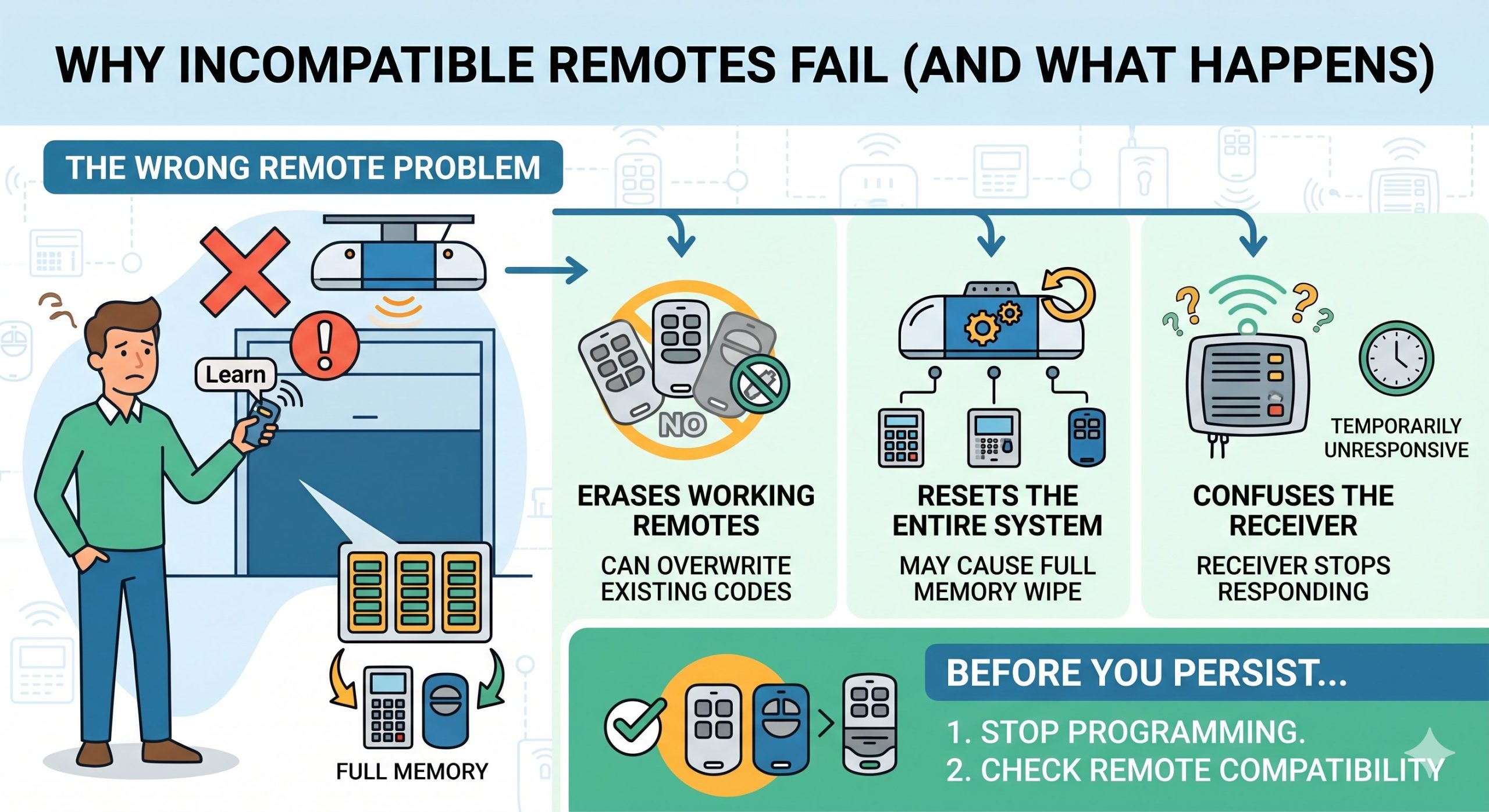
When a remote is not compatible, many homeowners respond by pressing the learn button and attempting to program it repeatedly. This seems harmless, but it can actually cause problems with your opener’s stored memory.
Here is what can go wrong:
- Erasing saved remotes: Most openers have a limited number of memory slots. Repeated failed programming attempts can sometimes overwrite or corrupt the codes of remotes that were previously working.
- Resetting the system: On some models, holding the learn button too long triggers a full memory reset, erasing all paired remotes including keypads and interior wall controls.
- Confusing the receiver: Sending unrecognized signals repeatedly can cause the opener’s receiver to become unresponsive temporarily.
If you have tried to program a remote multiple times without success, stop and verify compatibility before continuing. Persistence with the wrong remote can turn a simple problem into a larger one.
Security Vulnerabilities Can Open the Door to Unauthorized Access
Using an older or incompatible remote does not just risk operational failure. It can also expose your home to security risks that are easy to overlook but important to take seriously.
Security concerns to be aware of:
- Fixed-code remotes are easier to clone: Older remotes that use a fixed code broadcast the same signal every time. Code-grabbing devices can intercept and copy that signal, allowing someone to open your garage door without your knowledge.
- Generic or unverified remotes may lack encryption: Third-party remotes from unverified sources may not include the encryption features that protect modern systems.
- An unsecured garage is a common entry point: The most frequently targeted entry points in residential break-ins are when security measures are outdated or inadequate.
For homeowners in Cypress, TX, where neighborhood security is a priority, using the correct and fully compatible remote is a basic but essential layer of protection.
It Can Cause Erratic Door Behavior
In some cases, a partially compatible or incorrect remote does not just fail silently. It can send signals that your opener partially interprets, leading to unpredictable door behavior.
Signs of erratic behavior caused by an incompatible remote:
- The door starts to open and then immediately reverses
- The door opens when you press the open button and vice versa
- The opener activates on its own without any button being pressed
- The door stops mid-travel for no apparent reason
This type of behavior can place added strain on mechanical components such as springs, tracks, and the motor system. Over time, this repeated stress can lead to premature wear and garage door repair needs that could have been avoided with a properly matched remote.
It Can Damage the Opener’s Receiver
The receiver inside your garage door opener is designed to accept signals from compatible devices. When it is repeatedly exposed to unrecognized or mismatched signals, it can experience strain that shortens its lifespan.
What this looks like in practice:
- The receiver becomes less responsive over time, even to the correct remote
- The opener starts requiring multiple button presses to respond
- The system becomes unreliable in ways that are difficult to trace back to the original cause
Receiver damage is not always obvious right away. It often develops gradually, making it harder to connect the problem back to using the wrong remote in the first place. A qualified technician can test the receiver and determine whether it has been affected.
Warranty Coverage May Be Affected
Many garage door opener manufacturers include terms in their warranties that limit coverage when non-approved accessories or components are used with the system. Using an incompatible or third-party remote that causes damage may give the manufacturer grounds to deny a warranty claim.
Before purchasing any remote that is not made by or approved by your opener’s manufacturer, review your warranty documentation. The cost difference between a brand-approved remote and a generic alternative is rarely worth the risk of voiding coverage on a system that can be expensive to repair or replace.
Homeownership guidance on garage door systems emphasizes that product compatibility and proper component selection can influence long-term performance expectations, including manufacturer support considerations.
Tips to Avoid Using the Wrong Remote
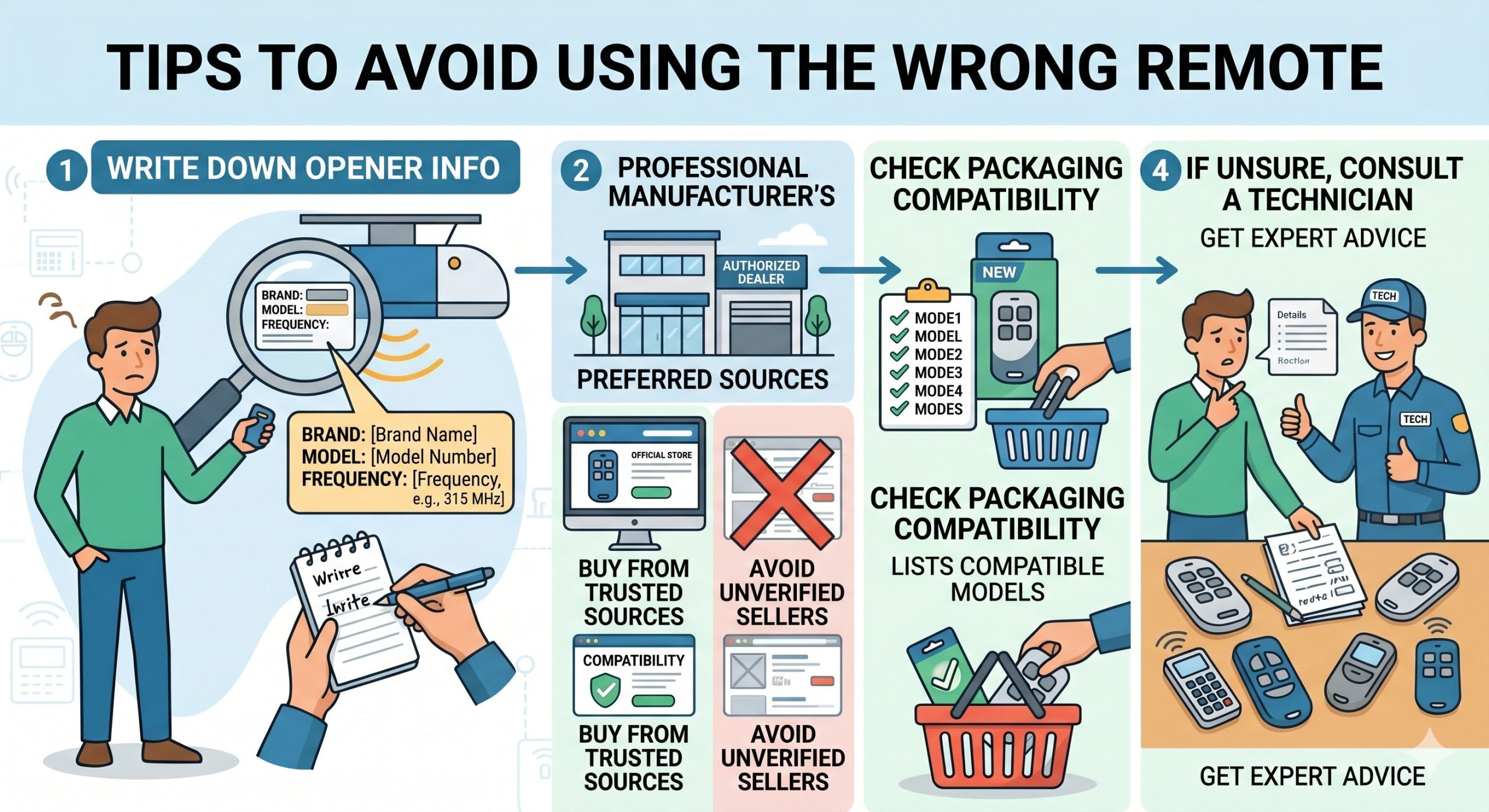
Prevention is straightforward once you know what to look for. Here is how to make sure you always choose the right remote for your system.
- Write down your opener’s brand, model number, and frequency before shopping
- Buy directly from the manufacturer or an authorized dealer when possible
- Avoid generic remotes from unverified sellers, especially online marketplaces with limited product details
- Check the packaging for a compatibility list before purchasing
- If you are unsure, consult a garage door technician before buying
Taking five minutes to verify compatibility before purchasing saves you from dealing with failed programming, erratic door behavior, and potential security gaps.
Troubleshooting guides for garage door systems recommend checking basic compatibility factors, such as setup configuration and system response, before replacing components to avoid unnecessary operational issues.
What to Do If You Have Already Used the Wrong Remote
If you have already attempted to use an incompatible remote and are now experiencing issues, here is how to approach the situation.
- Stop attempting to program the incompatible remote immediately
- Check whether your previously working remotes still function correctly
- If existing remotes no longer work, reprogram them using the learn button on your opener
- Inspect the door for any unusual behavior, such as reversing, stopping mid-travel, or activating on its own
- If the opener is unresponsive or behaving erratically, have a technician inspect the receiver and logic board
The sooner you address the issue, the less likely it is to develop into a more serious and costly problem. To understand the full scope of what replacing your remote involves, read When and How to Replace Your Garage Door Remote for a step-by-step breakdown of the process.
Getting It Right Protects More Than Just Your Opener
Compatibility is more than just a technical detail—it plays a key role in the safety and reliability of your garage door system every day. Using the wrong remote can lead to security risks, unnecessary strain on your opener, and issues that go far beyond a simple inconvenience. In a climate like Cypress, TX, where conditions can already stress your system, ensuring everything is properly matched from the start is the smarter, safer choice.
Garage Door Wizard delivers professional support for homeowners who want to be sure their remote and opener are fully compatible. Our experienced technicians will inspect your system, check for any hidden damage, and ensure everything is working securely and efficiently. If you have noticed issues or simply want peace of mind, contact us or give us a call to schedule your service visit.